





High aspirations, sound foundations: a discussion report on the centre-ground case for building 100,000 new public homes
In September 2015, at the Labour Party annual conference in Brighton, left-leaning think tank the Smith Institute published, High aspirations, sound foundations: a discussion report on the centre-ground case for building 100,000 new public homes, written by shadow housing minister John Healey MP. This followed the election of Jeremy Corbyn as Labour leader, with a stated intention of building 240,000 new homes a year.
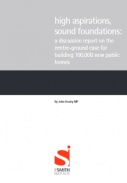
The report is intended to start a debate about what it describes as ‘the social housing crisis’ facing Britain. It suggests that there are alternatives to the government's housing policies, and sets out how Labour propose reviving social housing and reducing the housing benefits bill.
The report suggests that, ‘For decades we have not been building the new homes we need in Britain. The housing market has failed, is failing and will continue to fail. And when markets are failing, smart state intervention is imperative… It’s simply indefensible for government ministers to deny responsibility for ensuring people are decently housed and for helping the next generation get on. An affordable home isn’t a ‘nice to have’, it’s the bedrock for the lives and futures of individuals and families throughout the country.’
It points out that home ownership has fallen every year since 2010, homelessness and the cost of renting is rising, and that 63,000 social rented homes have been lost in the last five years. In 2015, just 124,500 new homes were built in England, which it suggests is half the number required to meet demand.
The central proposition of the paper is that, ‘...we can’t build the homes that our country needs to comfortably and affordably house our children and grandchildren without a substantial and sustained programme of public house-building.’ This it proposes is economically possible, because council and housing association homes not only generate income, but also help reduce the housing benefits bill through cheaper rents.
Healy suggests the need for new publicly-built housing has five key drivers:
- The inability of house-builders to build the homes people need by themselves.
- A housing costs crisis that affects millions of households.
- Affordable housing increases the incentive to work, making work pay for households on low incomes.
- Public investment in house-building provides an boost to the economy.
- New public housing investment can pay for itself.
The report sets out a series of policy changes which it claims could build 100,000 new public homes a year by 2020 and make the taxpayer a profit at the same time.
It then sets three challenges that must be met:
- Finding the language and arguments to justify the investment required.
- Persuading voters that investment in new affordable homes is a good use of public money.
- Scaling up public house building will require effort and innovation from all parts of the housing industry.
Featured articles and news

We're expanding our collaborative mission by launching DB Intelligence, an exclusive market research advisory panel. Built environment professionals can now get paid to share their expertise on industry trends, products and services.
Panel members receive direct financial incentives for participating in research projects like short surveys, 1-2-1 interviews and focus groups. Register today to shape the future of the construction sector.
Planning condition discharge in England and Wales

A brief exoplanation from a building compliance expert, with further links.
Overheating guidance and tools for building designers

Guidance for dealing with element of building fabric control that have increasing importance.
Shading for housing, a design guide

From the Good Homes Alliance and British Blind and Shutter Association.
UK Standard Skills Classification (SSC)

A shared framework for describing skills needs.
Social media ban consultation comes to close

CIOB urges UK Government to consider social media’s role in careers guidance in ban debate.
The latest of eight Skills England apprenticeship units

The addition of battery manufacturing welcomed by ECA with a warning about the risks of fast-tracked apprenticeship units.
Building Control Independent Panel final report

A precis of a key report led by Dame Hackitt with full recommendations and link to the government response.
Building Safety recap April, 2026
A short and longer run-through of the month, with links to further information and sources.

CIAT May 2026 briefing.

From medieval scribes to modern word art.

ECA welcomes crackdown on late payment and push for clean energy, whilst CIOB seek fixed cladding removal timeframes.
Cyber Security in the Built Environment

Protecting projects, data, and digital assets: A CIOB Academy TIS.
Managing competence in the built environment

ITFG publishes new industry guide on how to meet the ICC principles.

The UK's campaign to reduce noise pollution: Mythbusting, articles and topic guides.